Pontiac holds council calling for rebellion
April 27, 1763
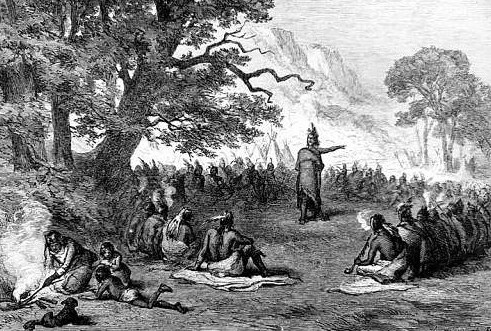 In a famous council on April 27, 1763, Pontiac urged listeners rise up against the British. 19th century engraving by Alfred Bobbett.
Obwaandi'eyaag (Pontiac) was an Odawa war chief who united Native peoples in the Great Lakes region to rise up in a generalized rebellion against British colonialism in the aftermath of the Seven Years War. The British had received the 'pays d'en haut' vast area of land in the Great Lakes region from France in the treaty which ended the Seven Years War in 1763. Local Indigenous peoples were unhappy with the increase in British settlers to the area and their poor treatment by the racist British commander-in-chief, General Jeffery Amherst. During this council, he called for an attack on Fort Detroit, and invoked the teachings of a popular Lenape religious leader, Neolin. Neolin's message was broadly for Native peoples to reject the goods and lifestyles of European settlers and return to traditional ways, specifically by rejecting alcohol, materialism, and polygamy. Pontiac successfully united the Pottawatomi, Hurons, and Ojibwe's to join his band of Odawa peoples on the attack on Fort Detroit. This is considered the beginning of what is referred to as Pontiac's Rebellion which spread to Native groups in eastern Illinois area Miamis, Weas, Kickapoos, Mascoutens, and Piankashaws, as well as Native groups in Ohio country such as the Lenape, Shawnees, Wyandots, and Mingos, many of whom had already been displaced from areas east.