Skirmish at Kemp's Landing
Nov. 15, 1775
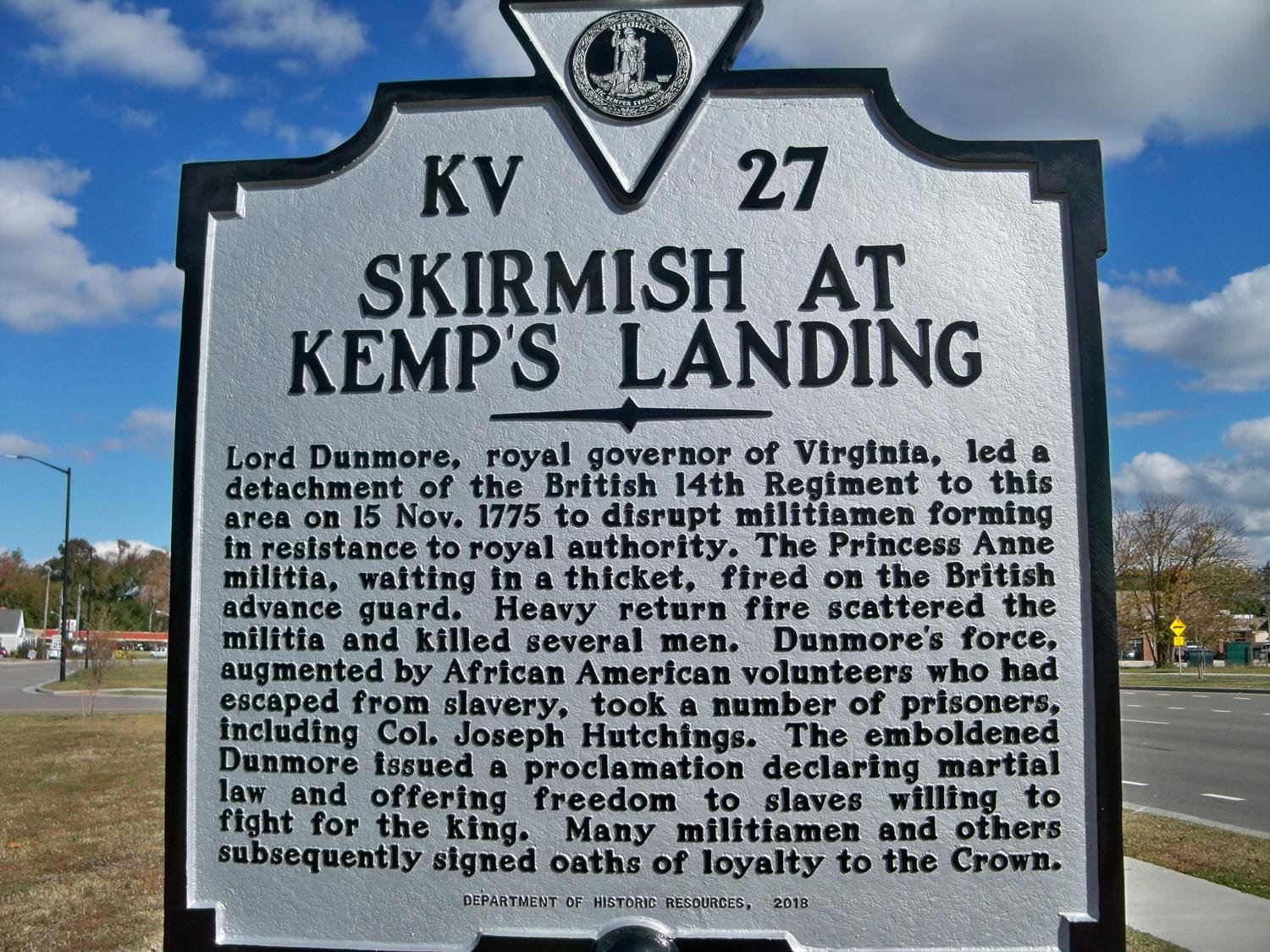
On this day in 1775, two formerly enslaved persons capture their former master, an American Patriot, during the Skirmish at Kemp’s Landing in Virginia, a skirmish between British forces and American Patriots during the American Counter-Revolutionary War.
As Andrew Lawler writes, “As early as September, a Patriot source estimated the Scottish earl [Lord Dunmore] had ‘about one hundred Negroes, and from twenty to thirty Tory volunteers’ to fight alongside two hundred or so redcoats and marines.”
“...on November 15, Dunmore led a force of redcoats and white and Black loyalists, including armed enslaved Africans, on a mission to seize patriot arms and ammunition at Kemp’s Landing, in what is now Virginia Beach. A patriot militia ambushed the column just outside of the small town, but Dunmore quickly rallied his men, and the Patriots fled into the neighboring swamp where several drowned.
"Two Black Loyalists, one armed only with a sword, chased Patriot leader Col. Joseph Hutchings, the Norfolk delegate to the Virginia Convention. The middle-aged officer, separated from his comrades, desperately tried to outrun his pursuers in the fading light. When they were just a few paces behind, he turned and pointed his pistol at a sword-carrying enemy. The shock of seeing the familiar face may have shaken his aim, since the gun flashed but the bullet missed its target. One of his adversaries took advantage of the moment to rush forward and slash him in the face with his sword. He and his companion then took the injured commander into custody and escorted him to Kemp’s Landing. The colonel and his assailant were acquainted: under Virginia law, Hutchings owned the unnamed man who had just captured him.”
“Dunmore immediately published his proclamation [freeing ‘all indentured servants, Negroes, or others’ under control of rebels, if they were ‘able and willing to bear arms.’], which was distributed widely in the colonies.” (Lawler, 2025, ‘Lord Dunmore’s Ethiopian Regiment’ at All Things Liberty)
The American Patriots’ Virginia Convention responds with its own declaration on December 14, 1775, threatening punishment of death to slaves who continue to fight, but amnesty to those who return to enslavement. The Committee of Safety is ordered to force returned slaves to work in the lead mine in Fincastle county.
Earlier in 1775, the Convention had praised Dunmore for fighting against the Shawnee and Mingo the year prior. Now, the convention claimed that the British government's Quebec Act of 1774 was intended "to draw down upon us a merciless and savage [a slur for Indigenous persons] enemy..."
The slave rebellion, the resistance of Indigenous peoples, and Britain’s attempt to ally with both groups, in part inspires the anti-Black and anti-Native sections of Thomas Paine’s ‘Common Sense’ and Thomas Jefferson's Declaration of Independence.
“There are thousands, and tens of thousands, who would think it glorious to expel from the continent, that barbarous and hellish power, which hath stirred up the Indians and Negroes to destroy us,” writes Paine, neglecting to mention that it was the actions of the American Patriots that had “stirred up” Black and Native peoples.
The American Declaration of Independence, in its final grievance, claims that the British King "has excited domestic insurrections amongst us, and has endeavoured to bring on the inhabitants of our frontiers, the merciless Indian Savages whose known rule of warfare, is an undistinguished destruction of all ages, sexes and conditions."
In reality, Black and Natives peoples were already fighting back before any British offers, and oppressed peoples don’t need to be fooled or swindled into fighting for their own freedom.
Slave escapes to British lines would reoccur during the War of 1812 and prior to the American Civil War.
America remains a hotbed for racist conspiracy theories to this very day.