Victoria's Black community helps Charles Mitchell escape from slavery in Olympia
Sept. 24, 1860
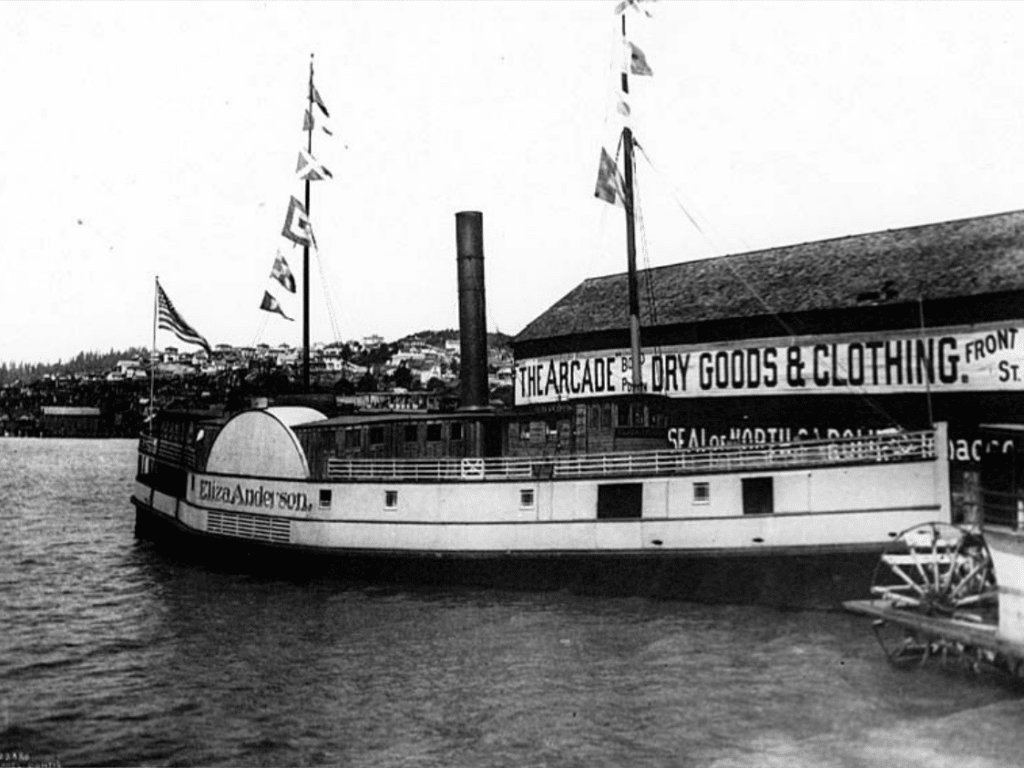 The sidewheel steamer Eliza Anderson at Yesler Wharf in Seattle circa 1884. Image by Asahel Curtis Photo Company, courtesy of the University of Washington Libraries Special Collections.
By Lorraine McConaghy, for the Maritime Washington National Heritage Area website: “[…] An African-Canadian man, William Jerome, spent some time in Olympia and noticed Charles Mitchell in the marketplace, the shops, and the street. [...] Jerome returned to Victoria and spoke with members of the Black community there. In 1860, Victoria was about 20% Black, following a mass migration of families of color from San Francisco, escaping California’s systemic racism. Victoria’s community included Black men and women who had participated in the underground railroad back East and who had helped many fugitive slaves escape to Canada.
With the help of that community, three Black men—James Allen, William Davis, and William Jerome—devised a plan to approach Charles Mitchell and aid in his escape to the freedom of Victoria on a maritime underground railroad. James Allen was the cook onboard the sidewheel steamer Eliza Anderson, which had the international mail run between Olympia and Victoria, pausing at flagged stops along the way. Two of the men approached Charles Mitchell in secret in Olympia and persuaded him to escape.
On September 24, 1860, Charles stole out of the Tilton house at dawn and ran down the hill to Percival Landing where the Eliza Anderson was getting up steam. Cook Allen was waiting for him and waved him on board, hustling him down to the galley and hiding him there. Davis was a passenger onboard the steamer, keeping an eye on Charles Mitchell.
The Eliza Anderson steamed north and stopped in Seattle so that a U.S. Army squad could search for deserters from Fort Steilacoom. They found no deserters, but they did find Charles Mitchell hidden in the galley. Hauled before the steamer’s captain, John Fleming, Mitchell was recognized as James Tilton’s property. The captain decided to return Mitchell to Tilton in Olympia and in the meantime Mitchell would work for his keep, shoveling coal to fuel the steam boiler.
As the Anderson steamed toward Victoria, Captain Fleming considered his position. Fleming decided to fire James Allen and put him off the vessel in Victoria. He had also likely guessed that passenger Davis was a member of the African-Canadian conspiracy “to set a bond boy free.”
At the Victoria waterfront, a large crowd awaited the Anderson’s docking. They jostled and murmured, “Where is the boy?!” Fleming announced from the steamer’s deck that he refused to release Charles Mitchell, who was locked up on board, and that he intended to return the boy to his master in Olympia.
The three African-Canadian conspirators rushed to the Victoria law office of barrister Henry Crease. There, they filed affidavits declaring their knowledge of Mitchell and his efforts to escape slavery in Olympia. Crease hastened to request a writ of habeas corpus from the civil authorities. The writ, delivered by Victoria’s sheriff and his burly deputy—and supported by an increasingly angry crowd—convinced Captain Fleming to reluctantly release Charles Mitchell to custody on shore.
After the boy’s night in jail, Crease represented him before the Supreme Court of Civil Justice, and Mitchell was freed. “It was,” editorialized the Victoria Colonist, “a righteous decision.” Charles Mitchell was free to grow up in the welcoming Black community of Victoria.
Owner James Tilton, Captain John Fleming, and Washington Territorial acting governor Henry McGill all wrote heated letters to protest Charles’ “seizure” as a violation of international marine law. Little came of their protests, though Mitchell’s escape was covered by newspapers up and down the West Coast. After his schooling in Victoria, Charles Mitchell joined many Black Victorians as they returned to San Francisco after the Civil War’s conclusion. [...]”
With the help of that community, three Black men—James Allen, William Davis, and William Jerome—devised a plan to approach Charles Mitchell and aid in his escape to the freedom of Victoria on a maritime underground railroad. James Allen was the cook onboard the sidewheel steamer Eliza Anderson, which had the international mail run between Olympia and Victoria, pausing at flagged stops along the way. Two of the men approached Charles Mitchell in secret in Olympia and persuaded him to escape.
On September 24, 1860, Charles stole out of the Tilton house at dawn and ran down the hill to Percival Landing where the Eliza Anderson was getting up steam. Cook Allen was waiting for him and waved him on board, hustling him down to the galley and hiding him there. Davis was a passenger onboard the steamer, keeping an eye on Charles Mitchell.
The Eliza Anderson steamed north and stopped in Seattle so that a U.S. Army squad could search for deserters from Fort Steilacoom. They found no deserters, but they did find Charles Mitchell hidden in the galley. Hauled before the steamer’s captain, John Fleming, Mitchell was recognized as James Tilton’s property. The captain decided to return Mitchell to Tilton in Olympia and in the meantime Mitchell would work for his keep, shoveling coal to fuel the steam boiler.
As the Anderson steamed toward Victoria, Captain Fleming considered his position. Fleming decided to fire James Allen and put him off the vessel in Victoria. He had also likely guessed that passenger Davis was a member of the African-Canadian conspiracy “to set a bond boy free.”
At the Victoria waterfront, a large crowd awaited the Anderson’s docking. They jostled and murmured, “Where is the boy?!” Fleming announced from the steamer’s deck that he refused to release Charles Mitchell, who was locked up on board, and that he intended to return the boy to his master in Olympia.
The three African-Canadian conspirators rushed to the Victoria law office of barrister Henry Crease. There, they filed affidavits declaring their knowledge of Mitchell and his efforts to escape slavery in Olympia. Crease hastened to request a writ of habeas corpus from the civil authorities. The writ, delivered by Victoria’s sheriff and his burly deputy—and supported by an increasingly angry crowd—convinced Captain Fleming to reluctantly release Charles Mitchell to custody on shore.
After the boy’s night in jail, Crease represented him before the Supreme Court of Civil Justice, and Mitchell was freed. “It was,” editorialized the Victoria Colonist, “a righteous decision.” Charles Mitchell was free to grow up in the welcoming Black community of Victoria.
Owner James Tilton, Captain John Fleming, and Washington Territorial acting governor Henry McGill all wrote heated letters to protest Charles’ “seizure” as a violation of international marine law. Little came of their protests, though Mitchell’s escape was covered by newspapers up and down the West Coast. After his schooling in Victoria, Charles Mitchell joined many Black Victorians as they returned to San Francisco after the Civil War’s conclusion. [...]”