RCMP attack Secwepemc land defence camp at Gustafsen Lake
Sept. 11, 1995
Excerpts from Warrior Publications: “In the summer of 1995, a month-long standoff occurred between Indigenous peoples & police near 100 Mile House, in the southern-interior region of British Columbia (BC). This land is the ancestral homeland of the Secwepemc (Shuswap).
Altogether, over 450 heavily-armed officers from various RCMP Emergency Response Teams (ERT), with military assistance, including 9 armoured personnel carriers, were deployed against some 24 defenders of a Sundance camp. In the end, it would be the largest RCMP paramilitary operation in Canadian history, costing over $5 million. Nearly half of this, $2.3 million, was for RCMP overtime.
The incident began after a local white rancher, Lyle James began demanding that a Secwepemc Sundance camp leave land to which he claimed ownership. Despite harassment from the rancher & his cowboys, members of the camp were determined to stay…
On September 11, RCMP & military personnel conducted an ambush of a defender’s vehicle. The red pick, used to get firewood and water, had been an annoying concern to RCMP members. In the days prior to Sept 11, plans were made to disable the truck. A senior officers’ notes describes this as:
“Chief Supt. Johnston advised that Supt. Olfert wants to get more proactive and take down the red truck and occupants if they can” (Brown’s notes, Sept 9/95, court disclosure).
Operations plans for this same day describes how the ambush was to occur:
“This operation will be conducted on a clear day when Wescam [aerial surveillance] is available to assist with surveillance… An ambush site will be determined after a thorough recci [recon] of the area… In the event of resistance, gas will be deployed at the vehicle and the occupants forced to surrender. The ambush team will be positioned on one side of the road and the Bison ahead of the ambush location and out of sight. Upon detonation, the Bison will approach the vehicle head on.”
In the dark, early morning hours of Sept 11, police & APCs are moved into position. ERT members are deployed as security forces, while an explosives team prepare to lay “datasheet” charges across the road. They use picks & shovels to dig a line in which to conceal the explosives. After placing the charge, they cover it & remove obvious traces of their work.
For several hours, the ERTs & APC waited in silence. Besides the Wescam surveillance, they also had a forward observation post to alert them when the vehicle was on its way. Later, as the truck drives down the dirt road, carrying two occupants and a dog, the ambush is executed.
As the truck’s front end passes over the charge, an ERT member detonates it and a massive explosion is set off. Later, the truck’s battery is found over 150 feet away, blown out of the truck by the force of the blast. A huge column of smoke billows into the air, and the area is engulfed in smoke & dust.
Dazed, the two occupants (Pitawanakwat & Bronson) flee the vehicle and began running into the forest, followed by their dog. A Bison emerges from the woods and smashes into the pick-up, twice. Police then approach the vehicle on foot, and find that the occupants are gone. They find an AK-47 and a rifle in the truck.
By this time, other had officers opened fire on the now-unarmed occupants as they fled, killing the dog (all of this is documented by Wescam, was released as court evidence, and can be seen in the documentary Above the Law, Part 2).
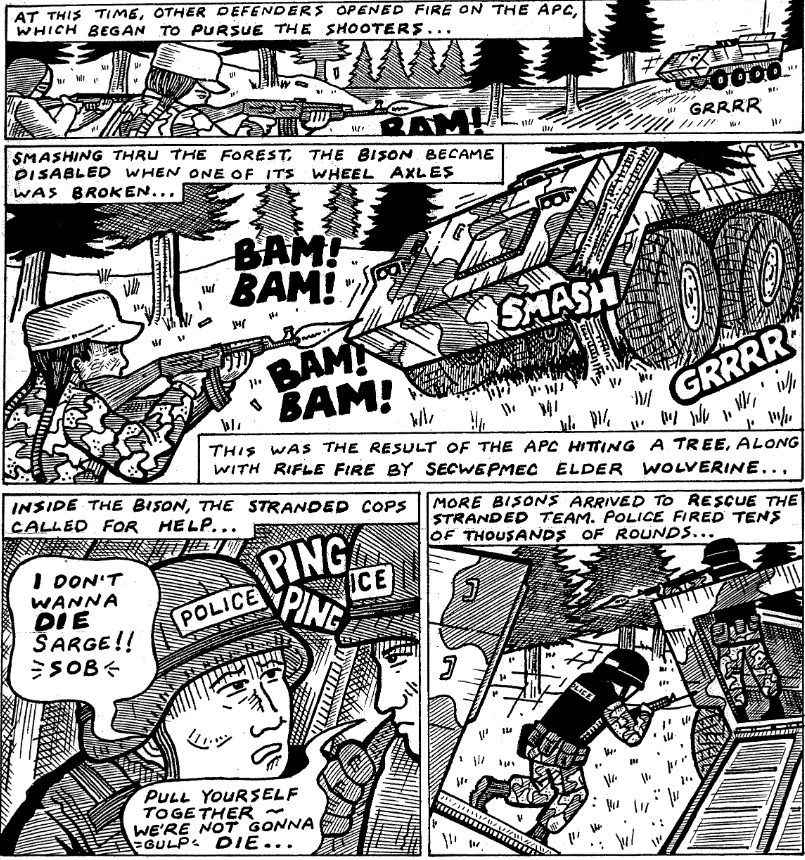
A police dog tracks the two to the lake, where they are seen wading across, still unarmed. The Bison moves to intercept them & waits on the other side. As they approach, RCMP standing in the open hatch of the Bison open fire. Bullets then hit the APC, and it moves off in pursuit of the two shooters, attempting to run them down (these shooters were the elder Wolverine & a younger warrior codenamed Shadow).
The Bison is then disabled, either by fire from Wolverine’s AK-47 directed at the wheels, or from breaking its axle on an overturned tree, or a combination of both. The police inside are trapped and wait for a second Bison to arrive, which is filled with members of Kamloops ERT. It backs up to the disabled Bison in order to rescue the stranded unit.
As rounds hit the APCs, one officer runs across the six feet of open ground separating the APC’s rear-doors. They decide it’s too dangerous to extract the remaining cops, and call for two more Bisons.
During this entire time, other ERT members at different locations across the lake are also firing in the direction of the Bisons. Some are as far as 1,500 meters away, far beyond the effective range of an M-16 (500 meters). During the trial, more than one officer admitted that some rounds that hit the APCs could have been “friendly-fire.”
Despite claims of hundreds of rounds striking the armoured vehicles, forensic analysts found that only 26 rounds had hit the disabled Bison. Altogether, between 150-200 rounds in total are fired by the defenders on Sept 11.
As for their firing thousands of rounds into the forest, RCMP later described this as “cover fire.”
One defender (Suniva Bronson) was hit in the arm with a .223 round.
As many as 60 RCMP officers were involved in the assault, with 20,000-77,000 rounds being fired. In contrast, only 200 or so were fired by defenders. The shooting & assault lasted approximately 3 hours…”
Altogether, over 450 heavily-armed officers from various RCMP Emergency Response Teams (ERT), with military assistance, including 9 armoured personnel carriers, were deployed against some 24 defenders of a Sundance camp. In the end, it would be the largest RCMP paramilitary operation in Canadian history, costing over $5 million. Nearly half of this, $2.3 million, was for RCMP overtime.
The incident began after a local white rancher, Lyle James began demanding that a Secwepemc Sundance camp leave land to which he claimed ownership. Despite harassment from the rancher & his cowboys, members of the camp were determined to stay…
On September 11, RCMP & military personnel conducted an ambush of a defender’s vehicle. The red pick, used to get firewood and water, had been an annoying concern to RCMP members. In the days prior to Sept 11, plans were made to disable the truck. A senior officers’ notes describes this as:
“Chief Supt. Johnston advised that Supt. Olfert wants to get more proactive and take down the red truck and occupants if they can” (Brown’s notes, Sept 9/95, court disclosure).
Operations plans for this same day describes how the ambush was to occur:
“This operation will be conducted on a clear day when Wescam [aerial surveillance] is available to assist with surveillance… An ambush site will be determined after a thorough recci [recon] of the area… In the event of resistance, gas will be deployed at the vehicle and the occupants forced to surrender. The ambush team will be positioned on one side of the road and the Bison ahead of the ambush location and out of sight. Upon detonation, the Bison will approach the vehicle head on.”
In the dark, early morning hours of Sept 11, police & APCs are moved into position. ERT members are deployed as security forces, while an explosives team prepare to lay “datasheet” charges across the road. They use picks & shovels to dig a line in which to conceal the explosives. After placing the charge, they cover it & remove obvious traces of their work.
For several hours, the ERTs & APC waited in silence. Besides the Wescam surveillance, they also had a forward observation post to alert them when the vehicle was on its way. Later, as the truck drives down the dirt road, carrying two occupants and a dog, the ambush is executed.
As the truck’s front end passes over the charge, an ERT member detonates it and a massive explosion is set off. Later, the truck’s battery is found over 150 feet away, blown out of the truck by the force of the blast. A huge column of smoke billows into the air, and the area is engulfed in smoke & dust.
Dazed, the two occupants (Pitawanakwat & Bronson) flee the vehicle and began running into the forest, followed by their dog. A Bison emerges from the woods and smashes into the pick-up, twice. Police then approach the vehicle on foot, and find that the occupants are gone. They find an AK-47 and a rifle in the truck.
By this time, other had officers opened fire on the now-unarmed occupants as they fled, killing the dog (all of this is documented by Wescam, was released as court evidence, and can be seen in the documentary Above the Law, Part 2).
A police dog tracks the two to the lake, where they are seen wading across, still unarmed. The Bison moves to intercept them & waits on the other side. As they approach, RCMP standing in the open hatch of the Bison open fire. Bullets then hit the APC, and it moves off in pursuit of the two shooters, attempting to run them down (these shooters were the elder Wolverine & a younger warrior codenamed Shadow).
The Bison is then disabled, either by fire from Wolverine’s AK-47 directed at the wheels, or from breaking its axle on an overturned tree, or a combination of both. The police inside are trapped and wait for a second Bison to arrive, which is filled with members of Kamloops ERT. It backs up to the disabled Bison in order to rescue the stranded unit.
As rounds hit the APCs, one officer runs across the six feet of open ground separating the APC’s rear-doors. They decide it’s too dangerous to extract the remaining cops, and call for two more Bisons.
During this entire time, other ERT members at different locations across the lake are also firing in the direction of the Bisons. Some are as far as 1,500 meters away, far beyond the effective range of an M-16 (500 meters). During the trial, more than one officer admitted that some rounds that hit the APCs could have been “friendly-fire.”
Despite claims of hundreds of rounds striking the armoured vehicles, forensic analysts found that only 26 rounds had hit the disabled Bison. Altogether, between 150-200 rounds in total are fired by the defenders on Sept 11.
As for their firing thousands of rounds into the forest, RCMP later described this as “cover fire.”
One defender (Suniva Bronson) was hit in the arm with a .223 round.
As many as 60 RCMP officers were involved in the assault, with 20,000-77,000 rounds being fired. In contrast, only 200 or so were fired by defenders. The shooting & assault lasted approximately 3 hours…”