Yamasee War begins
April 14, 1715
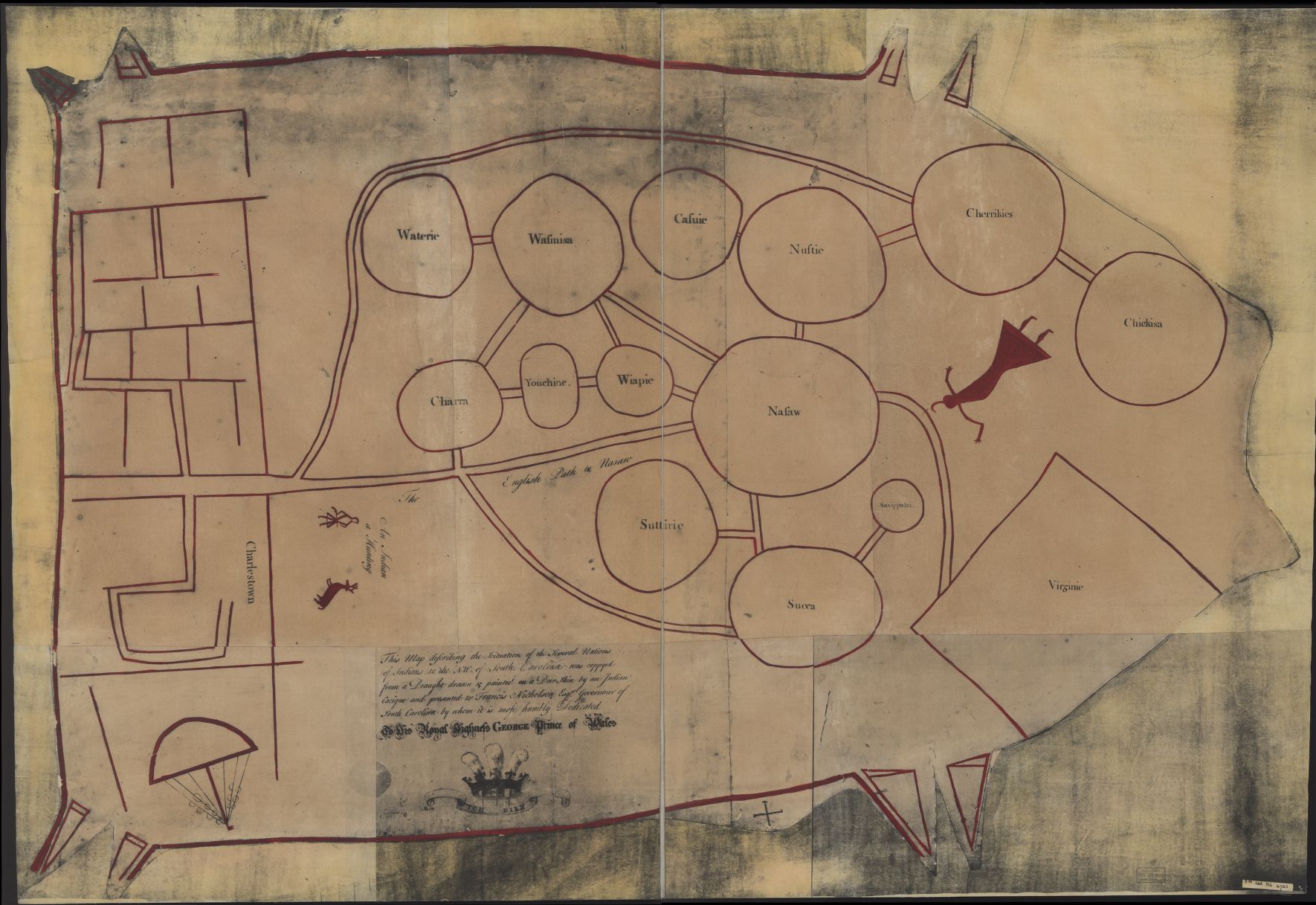 "Map of the Several Nations of Indians to the Northwest of South Carolina" or the "Catawba Deerskin Map", an annotated copy of hand-painted deerskin original made by a Catawba chieftain to Governor Francis Nicholson. Public Domain
The Yamasee war was a conflict between the Yamasee peoples with other allied tribes, and the settler colonial Province of Carolina. Other peoples allied with the Yamasee in this conflict include the Muscogee, Cherokee, Catawba, Apalachee, Apalachicola, Yuchi, Savannah River Shawnee, Congaree, Waxhaw, Pee Dee, Cape Fear, Cheraw, and others. The immediate background to the conflict was the Tuscarora war, in which many of the Native peoples involved against settlers in this war had fought on the side of the settlers against the Tuscarora's due to intertribal conflicts and colonial influences. Some argue that the Tuscarora war showed the remaining Indigenous peoples of the area how integral the slave trade in Native peoples was to the settlers and that was a part of them turning agains the settlers along with the usual reasons of settler violence, exploitative trading practices, and encroachment onto their lands. The uprising began with the killing of traders who were purposefully over extending credit to their Native partners and then demanding two years forced labor for every adult Yamasee based on the accumulating debt. On this date, Yamasee fighters killed white traders William Bray, Samuel Warner, and Nairne, and other tribes rose up to do the same. One source says "ally tribes, such as the Creeks, Choctaws, Apalachees, Saraws, Santees, and Waccamaws, also executed their traders, ninety percent of whom were killed by June 1715." The war continued until 1717 and had a profound influence, nearly wiping out the English colony altogether. The turning point which led to the defeat was the colonists convincing lower Cherokee forces to fight against the Creek (Muscogee), their traditional enemies. "The damage inflicted by the war was tremendous. The former prosperity of the trade in deerskins was not reached again until 1722. Carolina farmers had been driven from half the cultivated land in the colony. Approximately four hundred settlers had been killed, and property damage stood at £236,000 sterling. Military costs to defend the colony rested at £116,000 sterling, more than three times the combined value of all exports. No English colony came as close to eradication by a native population as South Carolina did during the Yamassee War." The war also had a major impact on the Native slave trade. Wikipedia: "the proportion of South Carolina households holding Native slaves declining from 26% in 1714 to 2% in 1730. This decline was also driven in part by legal changes which held slaves of both African and Native descent to be fully African, erasing many slaves of Native heritage from the historical record."