Executive Order establishing Lemhi Valley Indian Reservation for the mixed tribes of Shoshone, Bannock, and Sheepeater Indians
Feb. 12, 1875
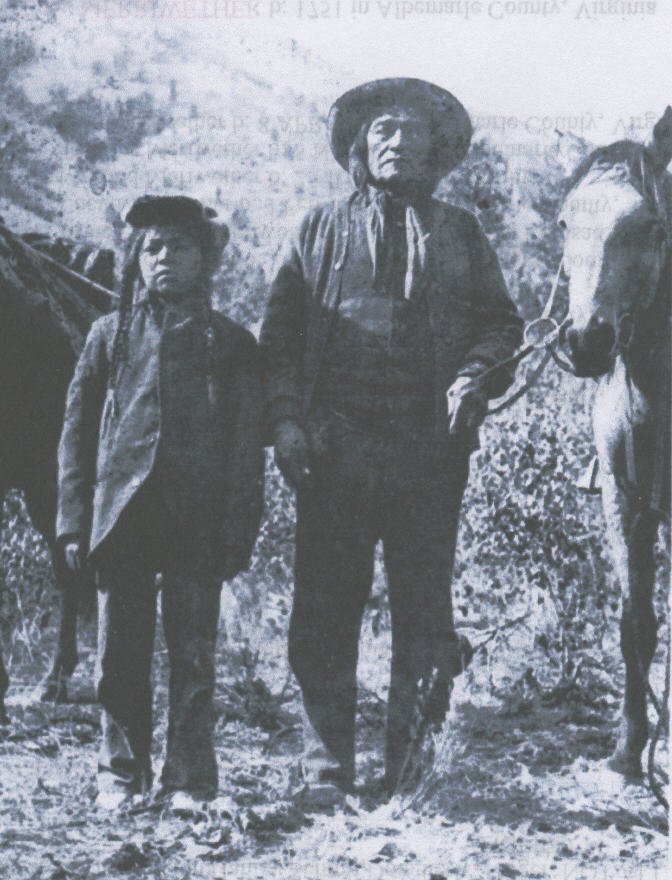 Tendoy and a son of his with a horse
On this day in 1875, President Grant established by executive order the reservation for the Lemhi Shoshone, following Chief Tendoy's long struggle for his people's land rights in the area. The Lemhi Shoshone refers to a mixed band of Shoshone, Bannock and Sheepeater Native peoples led by Tendoy who was himself of both Shoshone and Bannock descent. This reservation amounted to only about 0.1 acres per person. Tendoy led this band from 1863 until his death in 1907, firmly maintaining his peoples right to live in their Salmon and Lemhi River valley homelands. This executive order followed an 1868 treaty signed by Tendoy and others which was never ratified. While Tendoy is often remembered in settler history for keeping his band from engaging in warfare against the many armed conflicts between the US and other area Tribes, Tendoy resisted in his own way and how he felt best for the Lemhi Shoshone people. In particular he unceasingly agitated for land rights and against forced removal to Fort Hall, which the government tried to coerce him and his people into doing for decades. Although Tendoy and his band did not take part directly in the Bannock and Sheepeater wars, he allowed Native war refugees to shelter within the community afterwards. Tendoy also was very oppossed to both assimilationist Indian day schools and boarding schools for his people. One frustrated Indian Agent in 1888 wrote in his journal about forced assimilation; the "Indians generally were convinced that their ways and customs are far superior to those of the pale face and only make light of any argument to the contrary." Another in 1894 bemoaned, "an unfortunate trait in the character of these Indians- that of hospitality, which decreed that if one Indian has a supply of eatables in his house, the other need not go hungry so long as it lasts." Another example of Tendoy's opposition to the violence of residential school was in 1901 he physically resisted 4 Indian Police who came to take his grandson who had run away from school. They won and the boy went to family in Butte MT to avoid being taken again.
The Lemhi Shoshone mixed band eventually lost their long struggle to remain in the Lemhi Valley and were force marched in 1909 by federal troops to Fort Hall, two years after Tendoy's death. Tendoy never left the Lemhi valley and his grave overlooks the valley. Today we honor Tendoy and all the resistors long efforts to maintain their presence in their homeland. Their desendants today still travel to the Lemhi and Salmon River valleys to assert their sovereignty and remember their ancestors fight.
The Lemhi Shoshone mixed band eventually lost their long struggle to remain in the Lemhi Valley and were force marched in 1909 by federal troops to Fort Hall, two years after Tendoy's death. Tendoy never left the Lemhi valley and his grave overlooks the valley. Today we honor Tendoy and all the resistors long efforts to maintain their presence in their homeland. Their desendants today still travel to the Lemhi and Salmon River valleys to assert their sovereignty and remember their ancestors fight.