George Wright Drive renamed Whistalks Way in Spokane, WA
Dec. 14, 2020
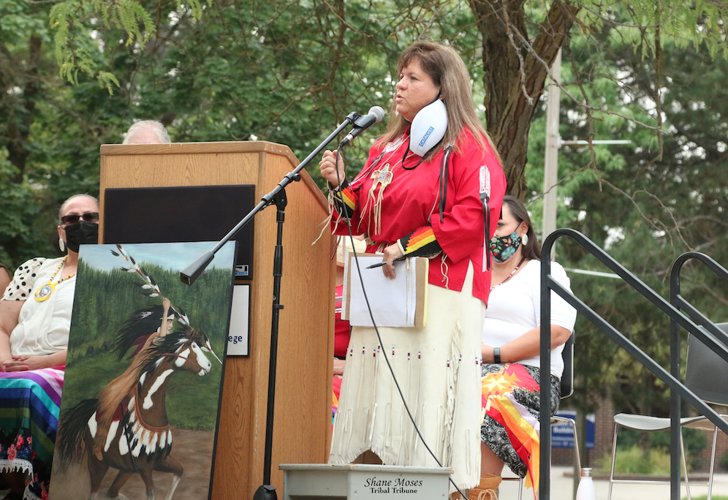 Margo Hill, Spokane tribal citizen, lawyer, and organizer who pushed for the renaming speaks at a ceremony honoring the name change and 80 Indigenous women. She stands at a podium in front of a painting of Whist-alks, who is remembered as throwing her lance into the ground and riding away from Wright after seeing her husband, Qualchan siezed and hung immediately after surrendering under a white flag.
On this day in 2020, Spokane City Council agrees to rename Fort George Wright Way to Whistalks Way, honoring a female Spokane warrior who defended her lands and peoples in the 1850's wars of resistance. Organized in part by Margo Hill, lawyer, an associate professor of urban and tribal planning at Eastern Washington University and a spokesperson for the Spokane Tribe, she said “It took until 2020, but we finally got it done. We took that man’s name off of our land, we will not honor genocide.”
US Army Colonel George Wright is remembered for his appointment to Washington territory in 1858 following Steptoe's Defeat, where he ran a harsh scorched earth campaign against Native defenders. He was particularly vicious after official surrender, and the final two battles near Spokane (Four Lakes and Battle of Spokane Plain). He hung without trial many Indigenous war prisoners and ordered and oversaw the slaughter of 900 horses, in an act of collective punishment and to ensure the poverty of the surviving Indigenous peoples. One of the people he hung without trial was Qualchan (Upper Yakama or Kittitas), who rode into his camp under a white flag with his wife, Whistalks, whose name means walks in the dress, who was the daughter of Chief Polotkin of the Spokane tribe. Wright seized Qualchan and hung him within 15 minutes. Whistalks escaped with Lokout, Qualchan's half brother and they both survived for many years, Lokout until 1912. They lived together near the confluence of the Spokane and Columbia rivers.
Today we remember Qualchan, a woman warrior who rode in multiple battles of the 1850's wars of resistance in what would become Washington State and we honor Indigenous women like Margo Hall, who continues the fight for the Spokane people. We thank her for her important work setting the record of history straight and for practicing Indigenous lifeways in Spokane. At the ceremony honoring the renaming of the street and Indigenous women in Spokane, Hall noted, “For the Spokane tribe, it was important not to just honor one woman, one individual. As tribal people, we don’t think as individuals, we think of our bands and our tribe and all of our people that is the way. So today we honor šinmsčín all the warrior women.”
US Army Colonel George Wright is remembered for his appointment to Washington territory in 1858 following Steptoe's Defeat, where he ran a harsh scorched earth campaign against Native defenders. He was particularly vicious after official surrender, and the final two battles near Spokane (Four Lakes and Battle of Spokane Plain). He hung without trial many Indigenous war prisoners and ordered and oversaw the slaughter of 900 horses, in an act of collective punishment and to ensure the poverty of the surviving Indigenous peoples. One of the people he hung without trial was Qualchan (Upper Yakama or Kittitas), who rode into his camp under a white flag with his wife, Whistalks, whose name means walks in the dress, who was the daughter of Chief Polotkin of the Spokane tribe. Wright seized Qualchan and hung him within 15 minutes. Whistalks escaped with Lokout, Qualchan's half brother and they both survived for many years, Lokout until 1912. They lived together near the confluence of the Spokane and Columbia rivers.
Today we remember Qualchan, a woman warrior who rode in multiple battles of the 1850's wars of resistance in what would become Washington State and we honor Indigenous women like Margo Hall, who continues the fight for the Spokane people. We thank her for her important work setting the record of history straight and for practicing Indigenous lifeways in Spokane. At the ceremony honoring the renaming of the street and Indigenous women in Spokane, Hall noted, “For the Spokane tribe, it was important not to just honor one woman, one individual. As tribal people, we don’t think as individuals, we think of our bands and our tribe and all of our people that is the way. So today we honor šinmsčín all the warrior women.”