Second Battle of Sitka (Tlingit resistance to Russian colonization)
Oct. 1, 1804
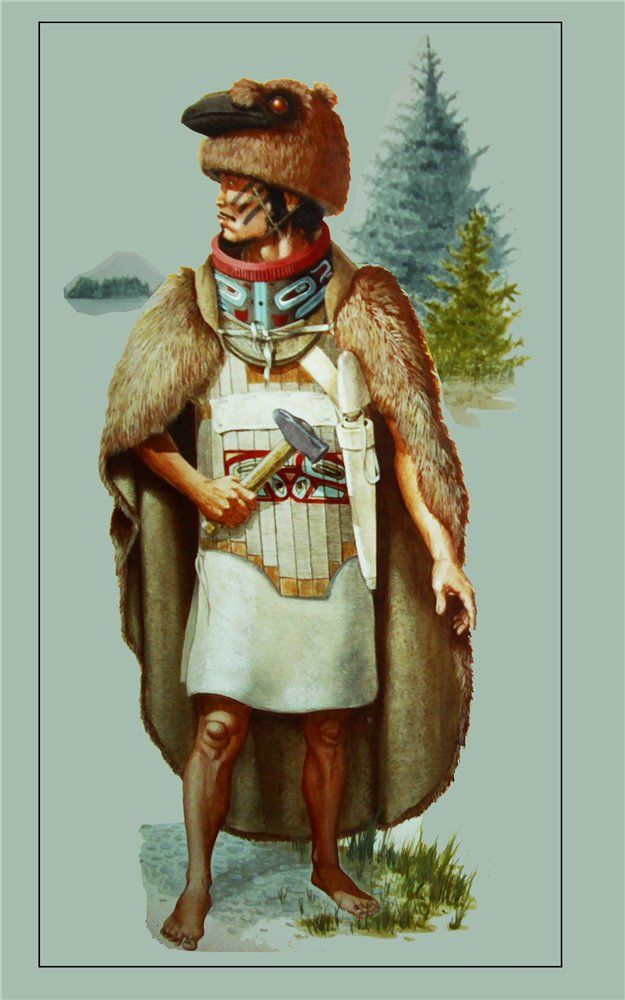 A modern reconstruction of a battle ready Katlian, leader of the Kiksadi clan and of the Tlingit resistance to the Russians in the Battle of Sitka. In addition to the Tlingit armor and dagger, Katlian wears his famous raven war helmet and he holds a Russian blacksmith's hammer that he acquired when storming the fortress of St. Archangel Michael in 1802. The hammer became his favorite weapon afterwards. Sitka National Historical Park.
Following the successful Tlingit destruction of Old Fort Sitka in 1802, the Russians returned to try to reestablish a presence in what would become southeast Alaska. Anticipating their possible return, the Kiks.ádi clan of Sheetʼká Xʼáatʼi established a fort at a location chosen to make cannon fire from Russian ships least effective. They built Shís'gi Noow or Fort of Young Saplings, with 14 buildings and a thick palisade wall that surrounded them, with a long shallow gravel shoal approach from sea.
An unfortunate accident occurred shortly after the Russian's arrival where a Tlingit canoe bearing an important store of gunpowder exploded. Despite this setback and other issues, the Kiks.ádi held the Russians off for five days, lead by War Chief Ḵʼalyaan.
Alexandr Baranof, the Chief Manager of the Russian-American company, was seriously wounded on day one of the battle and Lieutenant Commander Yuri Lisyansky assumed command.
Realizing the futility of staying under siege with a shortened supply of gunpowder, the Kiks.ádi decided on a strategic retreat to a village to the north, departing undetected under the cover of darkness, relocating to Chaatlk'aanoow, from which they could see any canoe or ship heading toward Sitka and take action. They effected a naval blockade of Sitka for 18 years.
American fur traders established a post across from Chaatlk'aanoow, trading weapons and other items to the Kiks.ádi. The blockade hurt Russian profits and in 1807, Baranov sent a message to Chief K'alyáan requesting the return of the Kiks.ádi and an end to the blockade. They refused and continued the blockade until 1822 when they returned home on their own terms, rebuilding outside the Russian fort. They announced, "the mountains around Sitka belong to the Sheet'ká Kiks.ádi. No Russians will be allowed to hunt for deer or bear on those mountains while the Sheet'ká Kiks.ádi are here."
An unfortunate accident occurred shortly after the Russian's arrival where a Tlingit canoe bearing an important store of gunpowder exploded. Despite this setback and other issues, the Kiks.ádi held the Russians off for five days, lead by War Chief Ḵʼalyaan.
Alexandr Baranof, the Chief Manager of the Russian-American company, was seriously wounded on day one of the battle and Lieutenant Commander Yuri Lisyansky assumed command.
Realizing the futility of staying under siege with a shortened supply of gunpowder, the Kiks.ádi decided on a strategic retreat to a village to the north, departing undetected under the cover of darkness, relocating to Chaatlk'aanoow, from which they could see any canoe or ship heading toward Sitka and take action. They effected a naval blockade of Sitka for 18 years.
American fur traders established a post across from Chaatlk'aanoow, trading weapons and other items to the Kiks.ádi. The blockade hurt Russian profits and in 1807, Baranov sent a message to Chief K'alyáan requesting the return of the Kiks.ádi and an end to the blockade. They refused and continued the blockade until 1822 when they returned home on their own terms, rebuilding outside the Russian fort. They announced, "the mountains around Sitka belong to the Sheet'ká Kiks.ádi. No Russians will be allowed to hunt for deer or bear on those mountains while the Sheet'ká Kiks.ádi are here."