South African Women Protest Pass Laws
Aug. 9, 1956
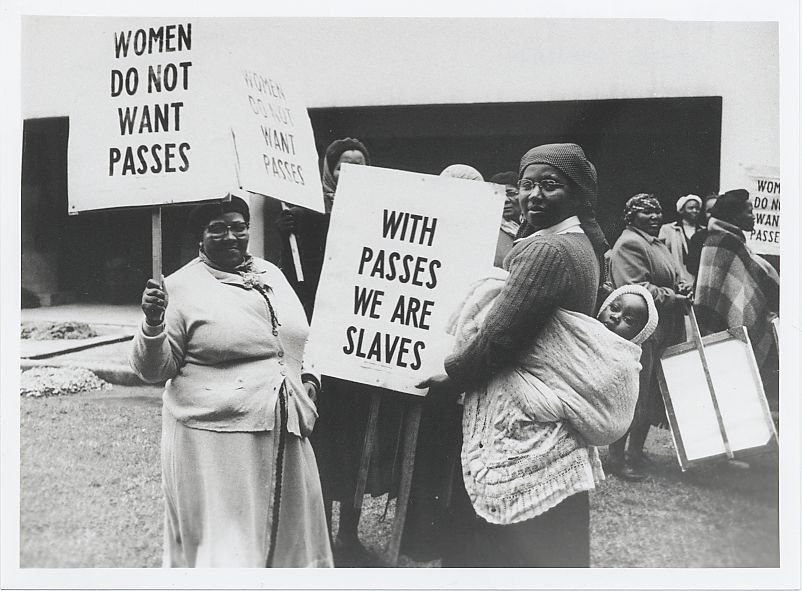 A group of women hold signs in demonstration against the pass laws in Cape Town on August 9, 1956, the same day as the massive women’s protest in Pretoria. Source: Facing History and Ourselves.
From Black Women Radicals Database:
"In one of the largest demonstrations staged in South African history, twenty thousand women of all races marched to the Union Buildings on August 9, 1956 in protest against the compulsory carrying of passes by African (Black) women. This march was significant for its multi-racial mobilization and the direct challenge it presented to the apartheid government, indicating that women would neither be silenced nor intimidated by unjust laws.
n urban areas, the women’s anti-passbook campaigns were primarily organized by the African National Congress (ANC) Women’s League and the non-racial Federation of South African Women (FEDSAW or FSAW). FEDSAW was founded in 1954. It was the first attempt to establish a broad-based women’s organization, without any particular political affiliation, though it was supported by some political organizations, clandestine and otherwise: the Communist party (prohibited in 1950) and the ANC (banned in 1960). 146 delegates, representing 230,000 women from all parts of South Africa, attended the founding conference of FEDSAW and pledged their support for the general campaigns of the Congress Alliance.
It took 12 years for the apartheid government to pass the bill that it had announced as early as 1950. The government had been delayed for three years because of women’s resistance, and the implementation of the law was extended with difficulty over the course of a decade. It was only on February 1, 1963 that the government was able to proclaim that all South African women had to own the pass that they had fought so long against.
This struggle brought South African women, black women in particular, into the political arena.[8] While the protests did not necessarily result in the gains the women had anticipated, they proved a vital, if hard, political apprenticeship. South African women continued in varying degrees to participate in liberation movements to free their country from apartheid, but the anti-passbook campaign is particularly significant for uniting women across races and spaces to take collective action for their rights."
We encourage you to read more about this struggle and many others on blackwomenradicals.com
"In one of the largest demonstrations staged in South African history, twenty thousand women of all races marched to the Union Buildings on August 9, 1956 in protest against the compulsory carrying of passes by African (Black) women. This march was significant for its multi-racial mobilization and the direct challenge it presented to the apartheid government, indicating that women would neither be silenced nor intimidated by unjust laws.
n urban areas, the women’s anti-passbook campaigns were primarily organized by the African National Congress (ANC) Women’s League and the non-racial Federation of South African Women (FEDSAW or FSAW). FEDSAW was founded in 1954. It was the first attempt to establish a broad-based women’s organization, without any particular political affiliation, though it was supported by some political organizations, clandestine and otherwise: the Communist party (prohibited in 1950) and the ANC (banned in 1960). 146 delegates, representing 230,000 women from all parts of South Africa, attended the founding conference of FEDSAW and pledged their support for the general campaigns of the Congress Alliance.
It took 12 years for the apartheid government to pass the bill that it had announced as early as 1950. The government had been delayed for three years because of women’s resistance, and the implementation of the law was extended with difficulty over the course of a decade. It was only on February 1, 1963 that the government was able to proclaim that all South African women had to own the pass that they had fought so long against.
This struggle brought South African women, black women in particular, into the political arena.[8] While the protests did not necessarily result in the gains the women had anticipated, they proved a vital, if hard, political apprenticeship. South African women continued in varying degrees to participate in liberation movements to free their country from apartheid, but the anti-passbook campaign is particularly significant for uniting women across races and spaces to take collective action for their rights."
We encourage you to read more about this struggle and many others on blackwomenradicals.com