Birthday of Dany Bébel-Gisler (Afro-Guadeloupean)
April 7, 1935
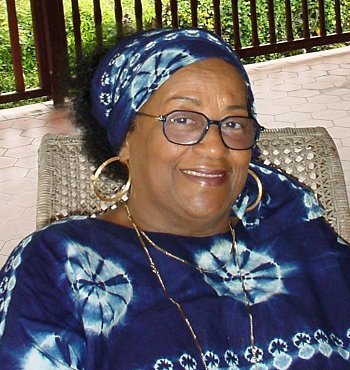 Photo © Thomas C. Spear. Retrieved from Île en île
From Wikipedia:
Dany Bébel-Gisler was an Afro-Guadeloupean writer and sociolinguist who specialized in Antillean Creole and ethnology. She was one of the first linguists to defend the preservation and teaching of Creole languages and study how the interplay of the lingua franca of the Caribbean reflected the social hierarchy, as well as the assimilation or lack thereof of both the colonizers and colonized. She was instrumental in the development of UNESCO's The Slave Route Project, tracing the intersection of African, Caribbean and European cultures and published several novels and children's books on Guadeloupean culture.
She published a booklet, Kèk Prinsip Pou Ékri Kréyól (Some Principles for Writing in Kreol), in 1975, and proposed designing a notational system for Guadeloupean Creole based upon the Haitian model which had been developed. In 1976, she published La Langue créole, force jugulée (The Creole language, forced suppression), which evaluated the system in French schools which placed immigrant children in remedial classes because they could not speak standard French.
In 1979, Bébel-Gisler founded the alternative-educational Centre d'Education Populaire Bwadoubout, to provide literacy for disadvantaged adults or children who wanted access to learning, but may have been obstructed because formal schools taught only in French. Her work at Bwadoubout undermined the governmental objectives of assimilation. Language became a vehicle for activism, for Bébel-Gisler, who recognized that controlling access to knowledge insured that certain social classes or those with certain backgrounds controlled the power. By refusing to use French, Guadeloupeans were creating a distinction between themselves, their colonizer, and other Antillean colonies, as well as rejecting assimilation.
Dany Bébel-Gisler was an Afro-Guadeloupean writer and sociolinguist who specialized in Antillean Creole and ethnology. She was one of the first linguists to defend the preservation and teaching of Creole languages and study how the interplay of the lingua franca of the Caribbean reflected the social hierarchy, as well as the assimilation or lack thereof of both the colonizers and colonized. She was instrumental in the development of UNESCO's The Slave Route Project, tracing the intersection of African, Caribbean and European cultures and published several novels and children's books on Guadeloupean culture.
She published a booklet, Kèk Prinsip Pou Ékri Kréyól (Some Principles for Writing in Kreol), in 1975, and proposed designing a notational system for Guadeloupean Creole based upon the Haitian model which had been developed. In 1976, she published La Langue créole, force jugulée (The Creole language, forced suppression), which evaluated the system in French schools which placed immigrant children in remedial classes because they could not speak standard French.
In 1979, Bébel-Gisler founded the alternative-educational Centre d'Education Populaire Bwadoubout, to provide literacy for disadvantaged adults or children who wanted access to learning, but may have been obstructed because formal schools taught only in French. Her work at Bwadoubout undermined the governmental objectives of assimilation. Language became a vehicle for activism, for Bébel-Gisler, who recognized that controlling access to knowledge insured that certain social classes or those with certain backgrounds controlled the power. By refusing to use French, Guadeloupeans were creating a distinction between themselves, their colonizer, and other Antillean colonies, as well as rejecting assimilation.