Morant Bay rebellion (Jamaica)
Oct. 11, 1865
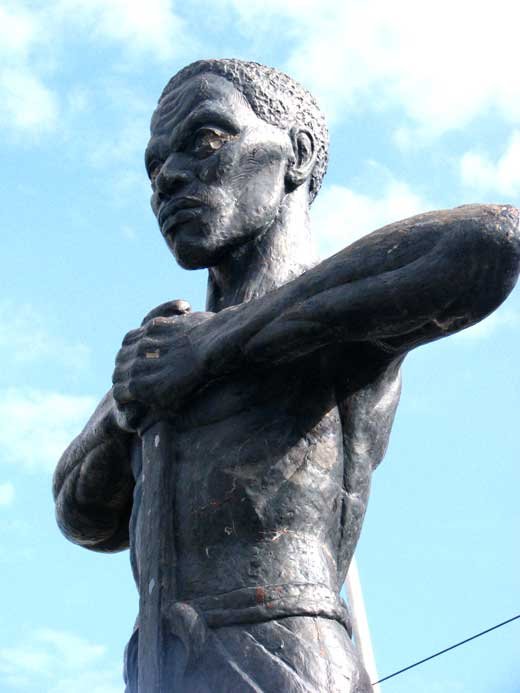 Paul Bogle statue Morant Bay, Jamaica
In 1865 Jamaice there was widespread poverty and racial injustice. While emancipation was on 1 August 1834, many Black Jamaicans were essentially unable to vote due to poll taxes and oppressed in nearly every possible way by the upper class. One main leader of the uprising was Paul Bogle, now a national hero to Jamaica, who was a Baptist deacon and activist concentrated on improving the lot of the poor. On 7 October 1865, Bogle and some supporters attended a trial of two men from Stony Gut. One was convicted and sentenced to prison on charges of trespassing on a long abandoned plantation. Bogle and supporters took to the market square where the police were severely beaten and forced to retreat. Two days later warrants were issued for Bogle and other's arrest for rioting. Police arriving in Stony Gut to make the arrests were met with resistance and forced to retreat to Morant Bay again. On 11 October 1865, there was a meeting of opposition in the Court House. Bogle and hundreds of followers, armed with sticks and machetes marched to confront them. The authorities had mustered a volunteer militia, who fired into the protesters after stones were thrown, killing seven men. The protesters set fire to the courthouse and nearby buildings. When those inside tried to leave, several were killed by the angry mob outside; a total of 25 on both sides died that day.
In the aftermath of the uprising, the governor declared martial law, sending troops who destroyed Stony Gut and Bogle's chapel, killing more than 400 persons outright across the parish, including women and children and arresting more than 300 people. Bogle and another leader George William Gordon were hanged for their part in the uprising. Beyond Bogle being remembered as a national hero in Jamaica for his resistance leadership, the uprising also led to major changes in the government structure in Jamaica. Following a Royal Commission, Jamaica was made a Crown Colony, governed directly by Britain. While the rebellion was put down violently, it ultimately achieved its objectives and paved the way for new attitudes in the country.
In the aftermath of the uprising, the governor declared martial law, sending troops who destroyed Stony Gut and Bogle's chapel, killing more than 400 persons outright across the parish, including women and children and arresting more than 300 people. Bogle and another leader George William Gordon were hanged for their part in the uprising. Beyond Bogle being remembered as a national hero in Jamaica for his resistance leadership, the uprising also led to major changes in the government structure in Jamaica. Following a Royal Commission, Jamaica was made a Crown Colony, governed directly by Britain. While the rebellion was put down violently, it ultimately achieved its objectives and paved the way for new attitudes in the country.