Battle of Toppenish Creek (Yakama Victory)
Oct. 5, 1855
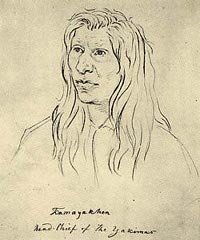 Kamiakin, Drawing by Gustav Sohon, 1855.
Drawing calls him 'Head Chief' which he would have protested, each Yakama band being autonomous. He was greatly respected and related to peoples in multiple bands however there are many records of him insisting that he speaks only for his band.
Kamiakin, Drawing by Gustav Sohon, 1855.
Drawing calls him 'Head Chief' which he would have protested, each Yakama band being autonomous. He was greatly respected and related to peoples in multiple bands however there are many records of him insisting that he speaks only for his band.
On this day in 1855, US Troops from The Dalles led by Maj. Granville O. Haller consisting of 102 soldiers and a mountain Howitzer were defeated by Yakama warriors led by Kamiakin and Qualchan and Sinkiuse (an Interior Salish people) warriors led by Quil-ten-e-nock at Toppenish Creek. The US aggression followed the killing of Indian Agent Bolon who was in Yakama territory to investigate the killings of settlers who had assaulted Native women. The battle is considered the opening battle of the Yakima Wars, sometimes lumped together with the Puget Sound War, both of which were wars of resistance to settler encroachment in the Pacific Northwest. As they started losing the battle, Haller’s men abandoned their pack train, and left their dead behind. Under darkness, Haller’s men began the march back to The Dalles, which, when the sun rose, turned into a running battle. One soldier was killed in the retreat, with a total of five of Haller’s soldiers were killed and 17 were wounded. Of Kamiakin’s force, only two were killed. News of the win also reached another US Army force from Fort Steilacoom, led by Lt. William Slaughter, who upon hearing the news turned back to hide at Fort Steilacoom. After the end of the Yakima War, Kamiakin refused to surrender, escaping to Canada and then living with Séliš, Ql̓ispé, and k̓upawiȼq̓nuk in what was called Flathead Indian Reservation in Montana for a time. He refused to recognize the treaty or encourage his people to submit to federal rule for the rest of his life.