Soweto youth uprising (South Africa)
June 16, 1976
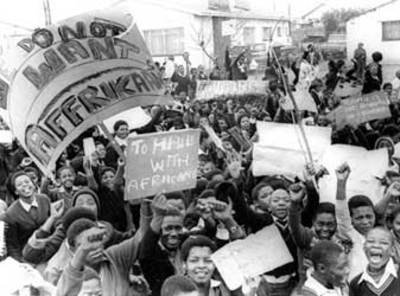 The Soweto Uprising,” Divestment for Humanity: The Anti-Apartheid Movement at the University of Michigan
On this day in 1976, the Soweto uprising began in part in response to a new policy of Afrikaans as the medium of instruction in schools. South Africa History Online points out that the basis for the uprising goes back at least to the passage of the Bantu Education Act introduced by the Apartheid government in 1953. Dr Verwoerd, who engineered the Bantu Education Act, announced that “Natives (blacks) must be taught from an early age that equality with Europeans (whites) is not for them”. Further, SA reports the government was spending far more on White education than on Black education; R644 was spent annually for each White student, while only R42 was budgeted for a Black school child.
On the day of the uprising, Action Committee of the Soweto Students Representative Council (SSRC), leaders of the original march, mainly came from two high schools, Naledi High in Naledi and Morris Isaacson in Mofolo. By the end of the day, an estimated 20,000 students took part in the protests which turned to generalized riots. The police fired teargas and live ammunition on demonstrating students with extreme brutality. The official count is that 176 protesters were killed, but actual estimates are much higher.
June 16 is now a public holiday in South Africa, Youth Day in remembrance.
On the day of the uprising, Action Committee of the Soweto Students Representative Council (SSRC), leaders of the original march, mainly came from two high schools, Naledi High in Naledi and Morris Isaacson in Mofolo. By the end of the day, an estimated 20,000 students took part in the protests which turned to generalized riots. The police fired teargas and live ammunition on demonstrating students with extreme brutality. The official count is that 176 protesters were killed, but actual estimates are much higher.
June 16 is now a public holiday in South Africa, Youth Day in remembrance.