Maji Maji Uprising
July 31, 1905
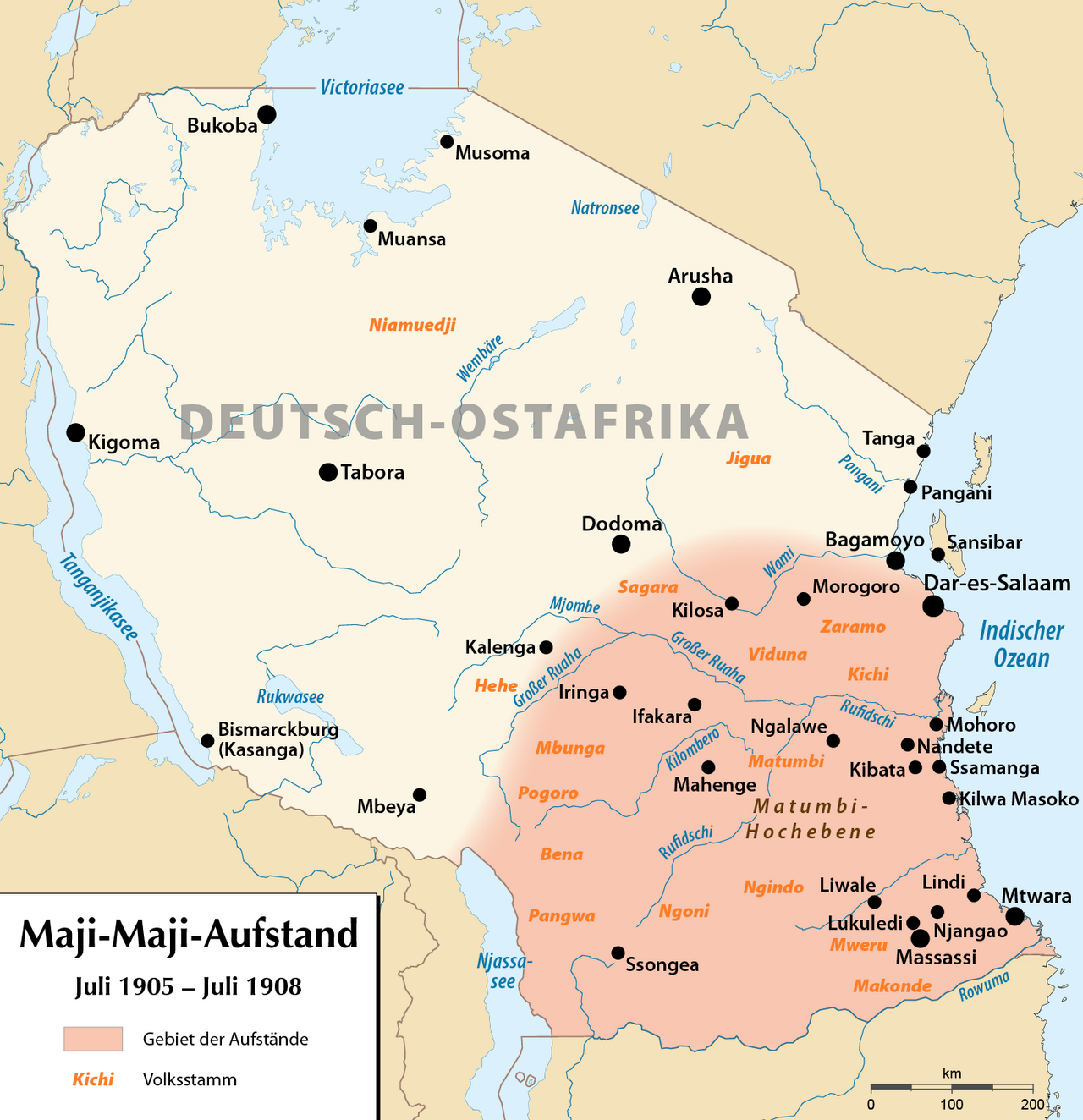 Map of German East Africa with the areas affected by the rebellion highlighted in red.
Among other colonial oppressions leading to the rebellion, in 1902, governor of German East Africa, Gustav Adolf von Götzen ordered villages to grow cotton as a cash crop for export. German policies in German East Africa (now Tanzania), were very oppressive and deeply unpopular. Finally a drought in 1905 caused conditions to worsen further. A prophet named Kinjikitile Ngwale, began calling himself Bokero and developed a belief that the people of East Africa had been called upon to eliminate the Germans. BlackPast reports: "The rebellion spread throughout the colony, eventually involving 20 different ethnic groups all of whom wished to dispel the German colonizers. As such it was the first significant example of interethnic cooperation in the battle against colonial control." On 31 July 1905, Matumbi tribesmen marched on Samanga and destroyed the cotton crop as well as a trading post.
Again from BlackPast:
"The apex of the rebellion came at Mahenge in August 1905 where several thousand Maji Maji warriors attacked but failed to overrun a German stronghold. On October 21, 1905 the Germans retaliated with an attack on the camp of the unsuspecting Ngoni people who had recently joined the rebellion. The Germans killed hundreds of men, women, and children. This attack marked the beginning of a brutal counteroffensive that left an estimated 75,000 Maji Maji warriors dead by 1907. The Germans also adopted famine as a weapon, purposely destroying the crops of suspected Maji Maji supporters.
Although the Maji Maji Uprising was ultimately unsuccessful, it forced Kaiser Wilhelm’s government in Berlin to institute reforms in their African colonies as they realized the potential cost of their brutality. Furthermore, the uprising would become an inspiration for later 20th Century freedom fighters who called for similar interethnic unity as they struggled against European colonial rule."
Again from BlackPast:
"The apex of the rebellion came at Mahenge in August 1905 where several thousand Maji Maji warriors attacked but failed to overrun a German stronghold. On October 21, 1905 the Germans retaliated with an attack on the camp of the unsuspecting Ngoni people who had recently joined the rebellion. The Germans killed hundreds of men, women, and children. This attack marked the beginning of a brutal counteroffensive that left an estimated 75,000 Maji Maji warriors dead by 1907. The Germans also adopted famine as a weapon, purposely destroying the crops of suspected Maji Maji supporters.
Although the Maji Maji Uprising was ultimately unsuccessful, it forced Kaiser Wilhelm’s government in Berlin to institute reforms in their African colonies as they realized the potential cost of their brutality. Furthermore, the uprising would become an inspiration for later 20th Century freedom fighters who called for similar interethnic unity as they struggled against European colonial rule."